
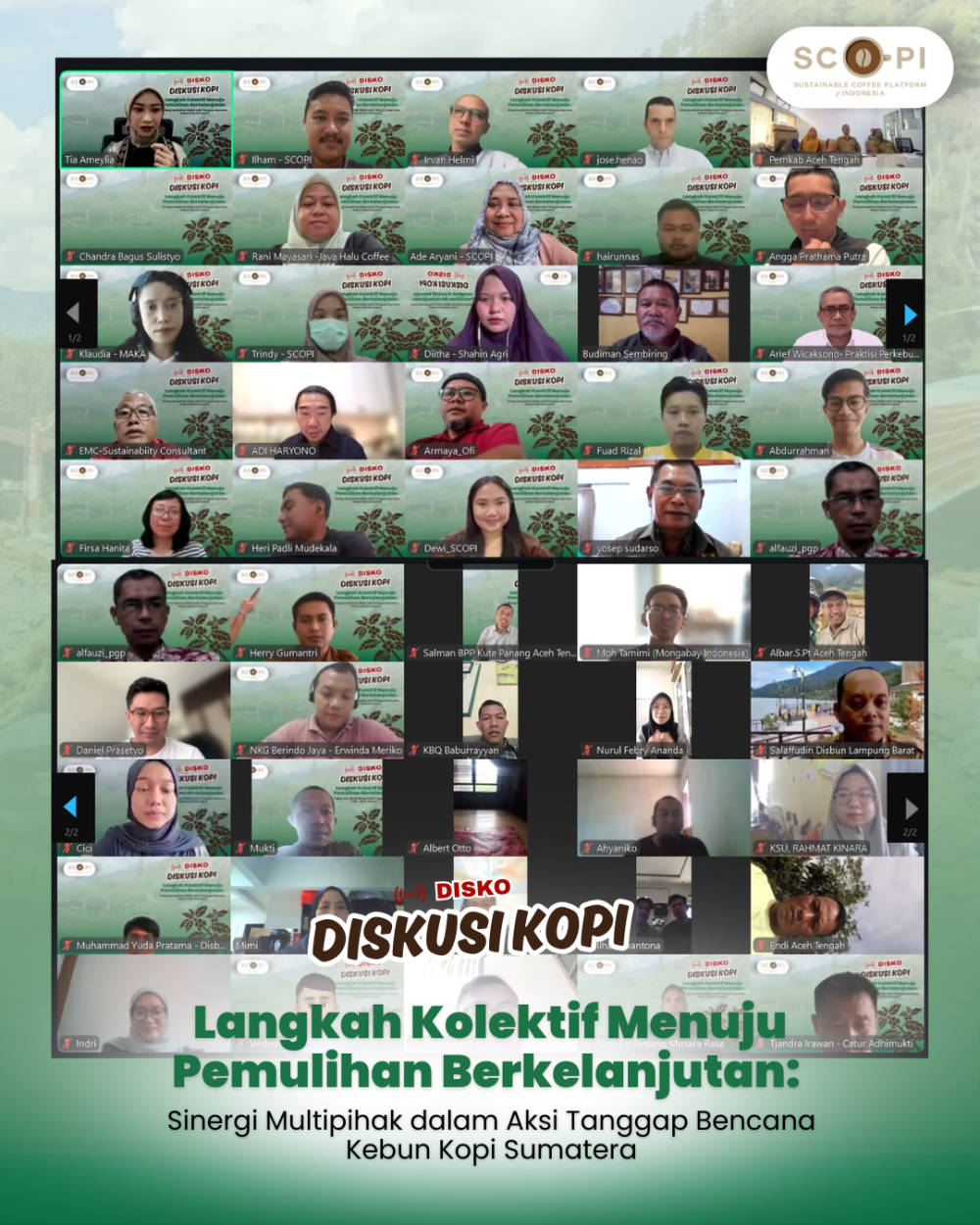
Collective Action to Restore Sumatra's Coffee Farms: SCOPI Mobilizes Multi-Stakeholder Synergy Post-Disaster
Jakarta – In response to the massive impact of flash floods and landslides that struck Sumatra’s arabica coffee growing area in late 2025, the Sustainable Coffee Platform of Indonesia (SCOPI) hosted an Online Coffee Discussion (DISKO) titled "Collective Action Toward Sustainable Recovery: Multi-Stakeholder Synergy in Sumatra Coffee Farm Disaster Response" on Tuesday (10/03/2026). The event served as a strategic platform for central and local governments, the private sector, and civil society organizations to align recovery initiatives and strategies for more than 17,000 hectares of affected coffee land in Aceh, North Sumatra, and West Sumatra.
In her opening remarks, Ade Aryani, Executive Director of SCOPI, emphasized the importance of cross-sectoral post-disaster collaboration. "This discussion is expected to provide vital input for the disaster recovery program in Sumatra. We need to deeply understand the challenges on the ground and gather a collective commitment to rebuild the coffee sector in affected areas," she stated.
The disaster in Sumatra has significantly affected national coffee performance, particularly for Arabica varieties. Christieni Maria, Head of the Coffee and Tea Commodity Division at the Directorate of Annual and Perennial Crops, Indonesian Ministry of Agriculture, explained that the government has designed an additional budget for rehabilitation. "In 2026, we are targeting coffee development across 86,000 hectares, with 18,812 hectares specifically allocated for disaster recovery in Aceh Province through the distribution of seeds and labor wages," she explained.
Representing the local government, Anshary, S.E., M.A.P., Expert Staff for Development, Economy, and Finance of Central Aceh, highlighted the critical condition of main infrastructure. He noted damage to 175 road sections hampering logistics, with 25% of coffee farms reported as affected. "The community desperately needs the restoration of plantation land and the recovery of production road infrastructure. We hope for concrete action for rehabilitation and reconstruction, as regional budgets are currently limited to emergency response," he said.
From the industry side, Jose Henao, General Manager of ofi Indonesia, reaffirmed the private sector’s commitment to maintaining market stability for farmers. "Although exporters face significant risks due to disrupted stock availability, existing contracts remain in place to ensure farmers' coffee continues to be sold. This is our responsibility to Indonesian coffee farmers," Jose asserted. He also emphasized that sustainability programs and mentoring must continue even during crises to maintain supply chain resilience.
Irvan Helmi, Chairman of the SCOPI Executive Board, underscored SCOPI's role as a convener in this recovery effort. He issued a strong call for stakeholders to avoid working in silos. "Our presence in this DISKO session is a vital first step to strengthen one another in the sustainable recovery of Sumatra's coffee farms," Irvan stated. He further stressed the importance of data synchronization to ensure that aid, such as seeds, aligns with local wisdom and specific land needs to prevent recurring flood risks.
Voice from the field by SCOPI Coffee Master Trainers (MT) reinforced the urgency of this action. Salman from Central Aceh highlighted logistics difficulties that have prompted farmers to adopt the wana tani (agroforestry) system for food security. Meanwhile, Budiman Sembiring reported that conditions in Tapanuli could lead to a production decline of up to 70%, urging the need for superior seeds and intensive technical assistance.
Moderator Angga Prathama Putra from WWF Indonesia concluded the session by highlighting the strategic role of neutral platforms like SCOPI in bridging collective action to ensure aid is targeted and not overlapping.
As of February 2026, through Phase 1 (Emergency Response), SCOPI has distributed IDR 160,226,000 out of a total IDR 341,361,000 raised. This aid has reached 951 households in 71 villages, distributed through the MT network across Aceh, North Sumatra, and West Sumatra.
About SCOPI The Sustainable Coffee Platform of Indonesia (SCOPI) is a non-profit association that bridges the Government, Private Sector, and Farmers to promote sustainable agricultural practices to improve farmer welfare and environmental sustainability. SCOPI is a member of the Global Coffee Platform (GCP) network.