
Building a Sustainable Coffee Agroforestry Ecosystem, SCOPI Officially Launches "Kopi TUMBUH Lestari" Program in Sanggau and Sigi
JAKARTA/SANGGAU – The Sustainable Coffee Platform of Indonesia (SCOPI) has officially launched the "Kopi TUMBUH Lestari" program, an initiative designed to strengthen the sustainable coffee agroforestry ecosystem in Indonesia.
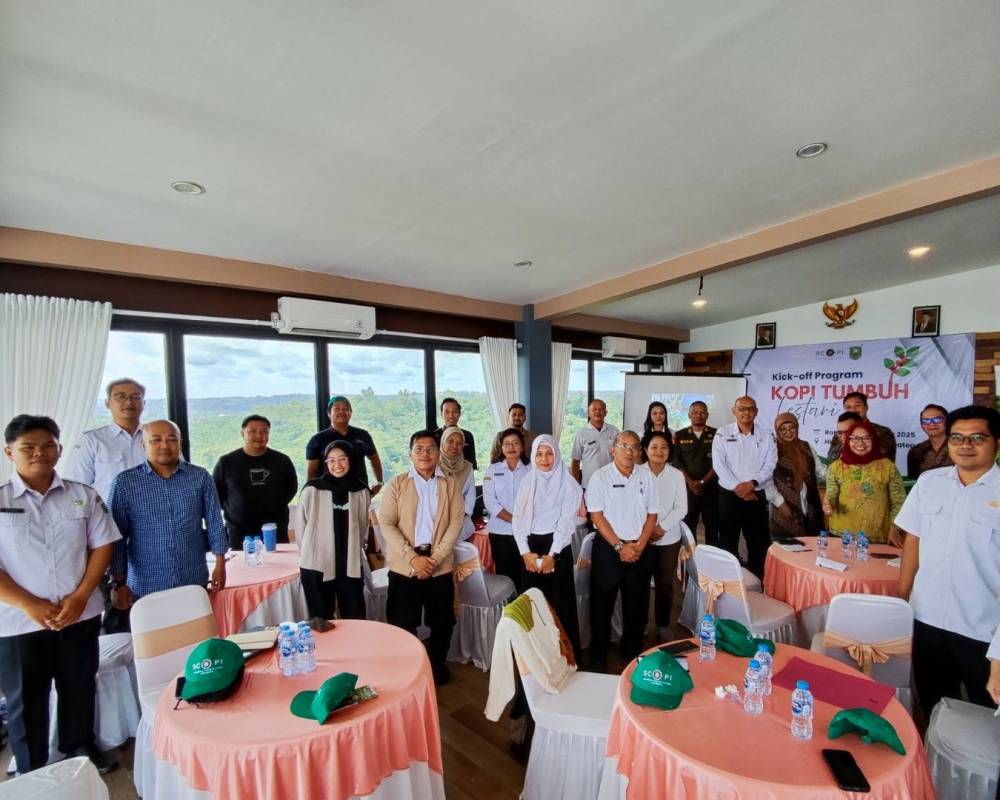
The program launch was marked by a series of Kick-off Meetings held in two key target areas: Sanggau Regency, West Kalimantan, on Wednesday (Nov 26, 2025) in person, and Sigi Regency, Central Sulawesi, on Wednesday (Dec 3, 2025) online.
The TUMBUH program (Tingkatkan Usaha Melalui Budidaya Unggul dan Hilirisasi) was developed to address challenges in the coffee sector in both regions, ranging from limited technical capacity of extension officers and farmers, product quality issues from business actors, to market access.
By utilizing a coffee agroforestry approach, implementing the National Sustainability Curriculum for Coffee (NSC), and maximizing SCOPI’s network as an association, the program targets the recruitment of Master Trainers (MT) with BNSP (National Professional Certification Agency) certification, capacity building for coffee farmers through Good Agricultural Practices, and connecting producers with buyers at both local and national levels.
Sanggau: Foundational New Territory, Weaving Collective Commitment
In his remarks in Sanggau, Irvan Helmi, Chairman of the SCOPI Executive Board, emphasized that West Kalimantan is "new territory" for SCOPI program interventions, which have historically been strong in 15 other coffee-producing provinces.
"For SCOPI, Sanggau is not merely an expansion of territory, but an opportunity to design a sustainable coffee foundation collectively from the start. We chose the 'TUMBUH' (Grow) philosophy because we want to grow an ecosystem, not just plant trees. We want Sanggau to become a role model for coffee agroforestry in Kalimantan," said the SCOPI Chairman.
Full support was also expressed by the Sanggau Regency Government. Shopiar Juliansyah, S.E., M.M., Acting Head of Bapperida Sanggau, welcomed the program as a momentum to accelerate coffee development in his region.
"We hope this program can leave a positive footprint and be integrated across regional agencies, even supporting the potential of coffee agrotourism in the future," he stated.
Echoing this sentiment, Eko Budi Santoso, S.Hut, representing the Head of the Environment and Forestry Service (LHK) of West Kalimantan Province, highlighted the significant potential of Liberica coffee on West Kalimantan's peatlands, which cover 2.6 million hectares.
"Social Forestry areas in West Kalimantan have great potential to be developed through a coffee agroforestry approach, including in Sanggau, as an effort for land rehabilitation while simultaneously increasing community income," he explained.
The series of activities in Sanggau did not stop at the ceremony. The SCOPI team, together with strategic partners such as Lingkar Temu Kabupaten Lestari (LTKL) and the Sabang Merah Berdompu Multistakeholder Forum (MSF), accompanied by Grand Master Trainer (GMT) Dr. Retno Hulupi, conducted field visits to capture the real conditions of candidate intervention sites.
The visit was conducted in Desa Menyabo, Tayan Hulu District, to inspect a 1.6-hectare coffee farm owned by a local farmer requiring intensive care assistance. The team also visited Desa Tae, Balai District, to observe the unique potential in the Customary Forest managed by the Social Forestry Group (KPS). In this location, a local coffee variety (ancient/amal coffee) was found growing in a ± 1-hectare customary forest area, serving as a source of seedlings for KPS members' plantation.
Sigi: Investing in Human Resources
Continuing the momentum from Sanggau, the kick-off in Sigi Regency was held online with a program focus on strengthening human resource (HR) capacity.
Irvan Helmi, Chairman of the SCOPI Executive Board, emphasized that although the program in Sigi has a compact duration (6 months), the goal is to lay a long-term foundation through investment in people (Human Capital).
"Sigi's greatest asset is not only its natural resources but also its people. MTs in Sigi will be encouraged to obtain BNSP Certification. This is state recognition that farmer mentoring is a professional occupation, ensuring its quality and sustainability," he emphasized.
The Provincial Government of Central Sulawesi, through the Head of the Plantation Division, Mr. Simpra Tajang, M.Si., acknowledged that the main challenge in Sigi is the lack of upstream capacity for farmer mentoring, even though the supply chain is quite good.
"Out of 11,000 hectares of coffee plantations in Central Sulawesi, 4,000 hectares are in Sigi. The Kopi TUMBUH program is very relevant to support the mentoring of our farmers," he said.
Drs. Sutopo Sapto Condro, MT, Assistant II of the Regional Secretariat representing the Regent of Sigi, added that the local government's current focus is on strengthening sustainable agriculture.
"We hope the kick-off of the Kopi TUMBUH Lestari program becomes the start of aligning perceptions among multi-stakeholders to build concrete cooperation in the coffee sector," he said.
Through this program, SCOPI invites all stakeholders—government, private sector, and farmers—to "weave roles" and not walk alone. The goal is to ensure Indonesian coffee is not only economically productive but also ecologically sustainable and improves farmer welfare.
About SCOPI The Sustainable Coffee Platform of Indonesia (SCOPI) is a non-profit association that bridges the Government, Private Sector, and Farmers to promote sustainable agricultural practices to improve farmer welfare and environmental sustainability. SCOPI is part of the Global Coffee Platform (GCP) network.
Media Contact: I Wayan Bayu Anggara Program Staff, SCOPI Secretariat Email: [email protected] Mobile: 089680098372 Website: www.scopi.or.id